Matching Alleles
For a more detailed analysis of GO terms among tagged genes, check out this new app from Matt Rich in the Jorgensen Lab.
GO Terms: Enrichment or Underrepresentation
Volcano plot of all GO terms. Hover over point to see details. Click and drag to zoom in, click the home icon to reset view.GO Parent Terms: Enrichment or Underrepresentation
Volcano plot of parent GO terms following semantic clustering, divided into 3 major categories. Selecting a parent updates the table below to only display GO terms in the selected cluster. Click 'Clear selection' to reset.GO Term enrichment table with numbers of tagged/untagged genes, odds ratio, and FDR-adjusted p-value. Use the column filters or search function to refine
In Progress
GO term annotations and genes with an allele genotype marked as in progress in the current database. Add more on the 'Submit Intent to Tag' Page
Most common GO terms
Click on a row to show the in-progress genes annotated with each GO term.


Gene Search
For a more detailed analysis of optimal insertion sites, also check out this new app from Matt Rich in the Jorgensen Lab.
Guide to CRISPR Primer Designs
About This Tool
This page provides computationally predicted CRISPR guide RNA and primer designs for endogenous protein tagging in C. elegans. Each design includes guide RNAs, CRISPR primers for homology arms, and genotyping primers.
How to Use This Tool
1. Search for a gene: Use the search box to find genes by name (e.g., unc-6) or WormBase ID (e.g., WBGene00006746).
2. Select a guide design: Click on a row in the table to view the primers and guide RNA in the genome browser. Click the ⊕ symbol to expand and see full primer sequences.
3. Review the genome browser: The interactive IGV browser shows guide RNA locations (green), CRISPR primers (orange/red), and genotyping primers (purple).
Understanding the Primers
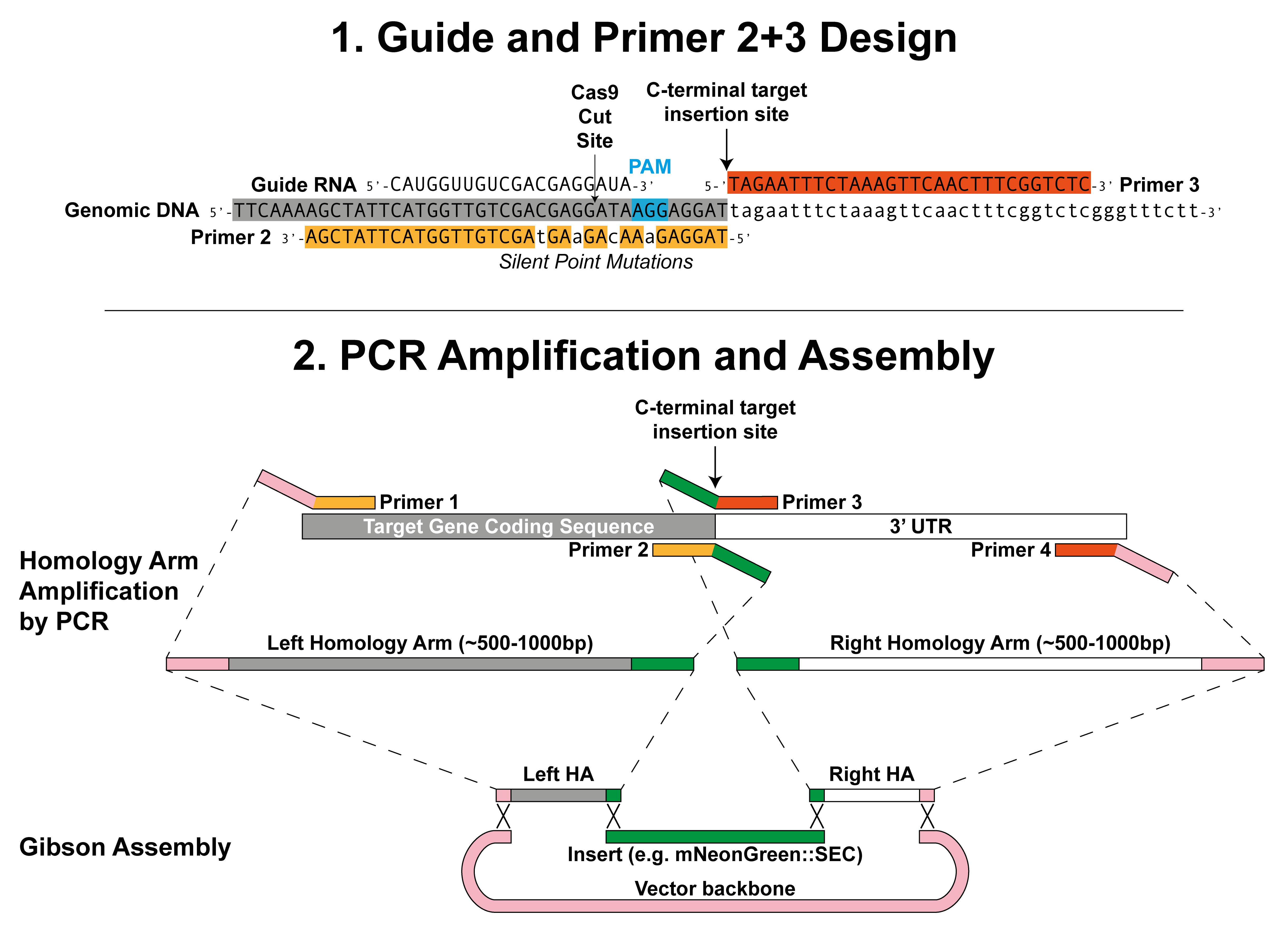
Primer 1: Outer primer for left homology arm amplification.
Primer 2/2B: Inner primer for left homology arm. Lowercase bases indicate silent mutations to prevent Cas9 from cutting the knock-in vector.
Primer 3/3B: Inner primer for right homology arm. Lowercase bases indicate silent mutations.
Primer 4: Outer primer for right homology arm amplification.
Primer 2A/3A: Additional primers for cases where the guide sequence is too far from the insertion site for the standard inner primers to reach.
Genotyping Primers: Forward and reverse primers to verify successful insertion via PCR. They can also be used for amplifying the genomic region for subsequent homology arm amplification, to avoid tricky PCR reactions with long/mutated/overhang-containing primers on genomic DNA directly.
Important Notes
- Overhang addition: When ordering primers, append the appropriate overhangs to your knock-in vector sequence to Primers 1-4. If Primer 2A or 3A exists, only append overhangs to Primers 2B and 3B (not to 2A and 3A).
- Lowercase bases: These indicate silent mutations introduced to disrupt the PAM site and prevent Cas9 from cutting your knock-in vector.
- Off-targets: Check the off-target column to see the number of off-target sequences with up to 4 bases mismatched. Designs with fewer off-targets are preferred.
- Distance to insert: Shows how far the guide cuts from the desired insertion site.
- Amplicon size: Expected PCR product size.
- Check before ordering: While every effort has been made to ensure the predicted sequences are correct and specific, errors are possible, so always verify the sequences before ordering and beginning cloning experiments.
Workflow Summary
1. Design vector overhang sequences onto the 5' end of Primers 1-4 (try to keep total length below ~60bp to reduce cost)
2. Order guide DNA and all required primers
3a. (Optional) Amplify the genomic region using the Genotyping Primers
3b. Amplify left and right homology arms using Primers 1+2 and Primers 3+4
3c. If a Primer 2A/3A exists, amplify with Primers 1+2A or Primers 3A+4 first, then add the rest of the HA sequence using Primers 1+2B or Primers 3B+4
4. Clone homology arms into your knock-in vector with appropriate overhangs (Gibson assembly)
5. Inject the completed repair template into young adult worms along with the guide and Cas9 (on DNA vector or as in vitro translated guide RNA + Cas9 protein)
6. Use genotyping primers to validate successful insertions
Guide Details
Genome Browser
About This Site
WormTagDB is a manually curated database of C. elegans genes that have had a fluorophore, epitope tag, degron tag, etc., knocked in at the native genomic locus to tag the endogenous protein.
To generate this database, we first performed a keyword-based Textpresso search to identify papers likely to contain endogenously tagged strains. After manually reviewing 2887 papers published before the 1st of September, 2026, we identified 1001 that performed such knock-ins, and extracted all reported endogenously tagged alleles. Analysis of the dataset's discovery curve indicates ~93% of all unique genes with published endogenous tags were captured. This list was then supplemented with strains available through the CGC. We invite researchers to submit their alleles to the database to make it more complete.
In addition to cataloguing existing knock-in strains, we generated optimal guide RNA and homology-arm primer sequences for every C. elegans protein-coding gene, allowing other labs to bypass this tedious design step and immediately begin building new knock-ins.
The goal is to provide a comprehensive, searchable resource of strains and reagents for researchers interested in protein regulation, localization, and function in vivo. For more information contact Jake Leyhr (Sherwood Lab @ Duke University).
Features
- Search across allele, gene, tag fields
- Search by GO terms and human disease associations
- GO term enrichment analysis
- Graphs of summary statistics
- Guide and homology arm primer predictions for all genes
- Announce genes you intend to tag in the near future
- Submit your new alleles to the database
Cite this app: Leyhr J., Chi Q., Zeng L., Li X., Cao B., Shen EZ., Zou W., Sherwood DR. (2026) WormTagDB: A Systematic Survey of Endogenously Tagged Proteins in C. elegans and Roadmap Towards the Tagged Proteome. G3 (Genes|Genomes|Genetics)
WormTagDB Shiny Code on GitHub
WormTagDB Guide and Primer Prediction Code on GitHub
Register your intent to tag genes
Use this page to let the community know which genes your lab plans to tag.
Gene catalogue
Click to add genes to the selected list.Select genes
Selected genes
Tag details and email submission
Enter a shared value in the first row, then use a column button to copy it to the other filled rows.Submit Endogenously Tagged Alleles
Noticed an endogenously tagged allele missing from the database? Add as many details as possible to the submission form below and click submit.
(Text can be pasted from an Excel document if convenient).
If an allele is unpublished, please provide your lab details (e.g. 'Sherwood Lab at Duke University') in the Publication field.
To report an attempted knock-in that was non-viable, describe the details in the comments field.
Check your email for a confirmation message. After a manual review of the information, we'll add it to the database.